


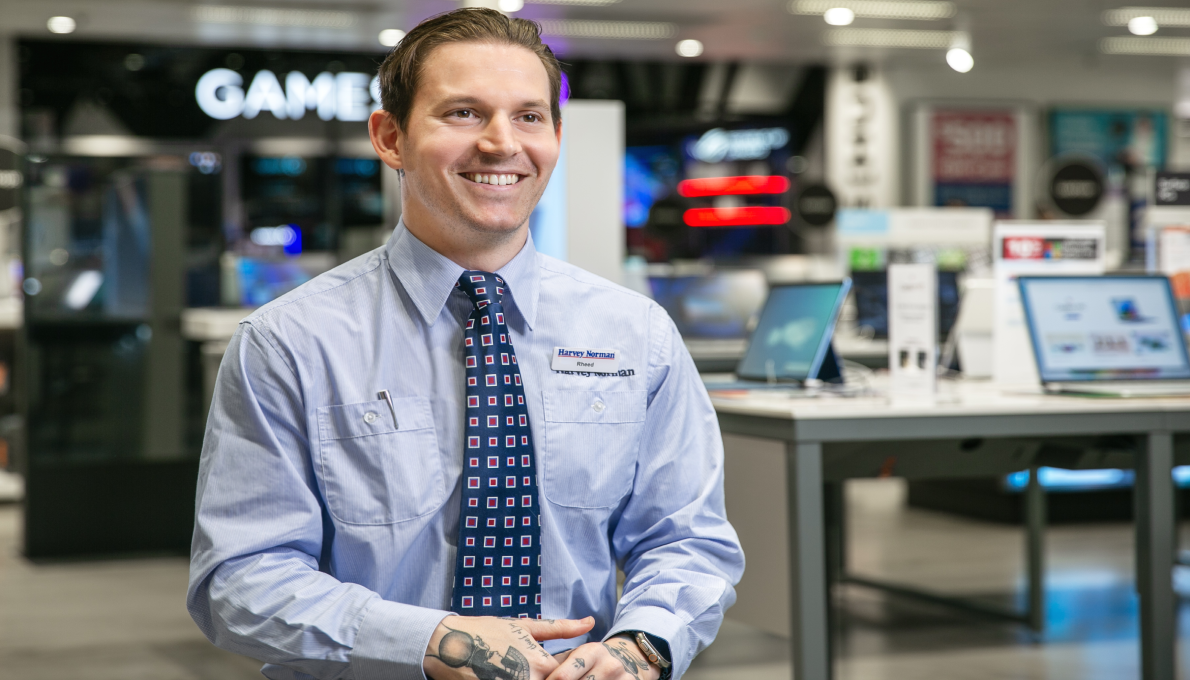

With Australia’s most successful Olympics yet in the rear-view and the Paralympic games close on the horizon, the nation looks to Paris once again, hoping to cheer on our amazing team toward further success. To celebrate the occasion, Harvey Norman joined four-time Paralympian and current Harvey Norman employee, Rheed McCracken to get an insight into his preparations for the Paris 2024 Paralympic Games.
How have your preparations and training been in the past few months in the lead up to the Paralympic Games?
The last few months have been really good. Not to say previous years I haven’t worked as hard, but this year I’ve changed a lot in my life on and off the track to try and be a better person and more comfortable in myself which has then reflected to being more confident and comfortable on the track.
I’ve been working with Louise Savage, and this is the biggest block I’ve done with her. Last year was still fresh working with her and we were still trying to find our way working together, whereas this year we have worked through that. I’m excited as we’ve really switched things up since Tokyo so I’m looking forward to seeing how that all pans out. I didn’t get the results I wanted at the World Championships last year so I’m really looking forward to getting back out on the track in front of crowds at the Paralympics.
What’s your mantra for tough training days?
I like to think in my head, if it’s really windy outside or raining, if my competitor was here would they do the session or would they go, ‘We’ll just wait for tomorrow when it’s clearer?’. I’m trying to make sure the things I am doing, I am doing them well no matter the conditions.
If it’s windy or cold, especially in winter, I’m asking myself, “are your competitors still training? Or are they finding an alternative?” because we have the chance to do the session. This gives you an edge.
What’s one sacrifice you’ve made for your sport?
I wouldn’t say there’s one sacrifice that stands out, however, I have learnt to be a little bit more selfish, to be able to make better decisions for myself, and that’s something I’ve had to learn over time. I’m 27 now and heading into my fourth Paralympics so it’s taken me a long time to realise that I need to put myself first when training and preparing for the Paralympic Games.
I’ve missed out on a lot of things that I would love to be able to do. It was my sister’s 30th birthday this week and I would have loved to have been there to celebrate with her, but I had to make a selfish decision to miss out as I’m flying out to the Paralympic Games next week.
I wouldn’t say there’s been one specific sacrifice I’ve made – it’s been a bunch of little sacrifices I’ve had to make over the years.
What’s one lesson your sport has taught you about life?
There’s a lot of things I’ve taken from sport which has translated into my job since now working. Having the mindset of an athlete and never doing anything that’s half-assed when I get out on the track – I’m always trying to be the best when I’m on the track and that comes into play in the working environment too. I try to have the same energy and mentality towards my job as I do with my sport.
Work has also taught me a lot about life and has changed how I approach my life. Since starting my new job, I have also been able to find a difference between the different versions of myself – ‘Athlete Rheed’, ‘Work Rheed’ and ‘Everyday Rheed’. Without having the balance, you just get so stuck in being ‘that’ athlete side and people never get to see who you really are. I have trained much better since working, as I haven’t been stuck in a bubble of only training – it’s given me a new little kick towards wanting to better in sport and be better in work.
How does it feel representing your country at the Paralympics?
The cliché is that it means everything, but it honestly does. It’s not just because you’re out on the track and you want to win a Paralympic medal, but it’s also about the people that have supported you and put time and energy into you. It’s about the sacrifices they’ve made for you, as well as the sacrifices you’ve made.
To represent Australia is a huge honour – whether that’s for World Championships or the Paralympics. You can do it as many times as you want, but every time you represent your country it’s amazing – there’s nothing better.
Do you have any pre-race rituals?
With being a bit older now and calmer with how I approach racing, I have changed my pre-race rituals. I used to think I would need to get up early, pack my bag early and have things really organised, but I realised that was just stress in my head.
I do have one ritual where I will race in the same race suit for the whole games. I have three suits, but I’ll just train in two, and the one that I have the best session in, I’ll choose that one and use it as my racing suit. I have always done that, ever since London.
How do you feel moments before you compete?
I feel all the stress and anxiety, that’s just natural when you are about to go out on the track and compete. I feel the most stress in the call room and then once I roll onto the track there’s no nerves, because I like to believe I have done what I need to do. There are no nerves because that’s when you can show your confidence. You look at your competition and we’ve raced each other for a long time, and you can see the ones that are stressed, you try not to be that person. That’s the best time to express your confidence and back what you’ve done and know what you’ve done is going to be enough.
People even ask me at work ‘will you be nervous when you’re on the track before the race starts.’ I won’t be nervous, and I love that you know you’ve done the hard work. That’s also the environment that I’m most comfortable in. An athletics track is where I know I need to be and I know what I need to do, so that’s where I’m most comfortable and confident.
What’s one message you’d give to young athletes?
Everyone has a different dream, but everyone also has different pathway of getting to that. For me, I always say I was very fortunate in the sense that I met the right people who introduced me to the right people, but my mentality was that I was always going to get where I wanted to be regardless; I just had to go down a different path for it. I think my message to kids is that even if the path does seem long, it’ll get you there if you’re willing to put the hard work in and make it. I think sometimes, we see people who just make it or are fortunate to be in a certain situation, but you can make your own path.
Just to see kids continuing in sport is important, and not withdrawing. When I was younger, I didn’t really have the ambition to do sport. I was doing it because my sister was doing sport and I wanted to be social. Then I found a little bit of a competitive edge. For the most part, just having kids around the sport, even if they don’t have the desire yet, they can still find it and then find their path into sport.
What legacy do you want to leave in your sport?
It’s not necessarily a legacy I want to leave, just inspiring people to chase your dreams and to keep going. If we can have people be able to see us and see what we did as a collective and as a whole Paralympic Team — if kids can see that and be inspired by that and want to be a part of that and move the Paralympic movement forward each time — because eventually and unfortunately, we get older and end up retiring. There needs to be another group come through, and I would love to be able to finish my career and see another generation of kids coming through. That I could see and then sit there and say, ‘They’re going to be amazing athletes,’ that would be really cool. I want to sit on the couch when I’m retired and see Paralympics strong with kids that are just smashing it past what I could have ever done.
What are you most looking forward to in the village and Paris?
What I’m looking forward to most honestly is — because Tokyo was covid affected, no crowds — I look forward to seeing that atmosphere back in the stadium. Also, seeing the village go back to normality, even though they’ll still have some restrictions.
Being able to see the atmosphere and compete for Australia again in a full stadium. I honestly don’t feel like I could have done any more for these games. I feel ready and excited, I feel confident in myself.
Will you see any other sports?
I’m going to try and go to the rugby. I’m really good friends with Riley Batt so I wouldn’t mind going and seeing that. I want to watch my roommate Sam McIntosh, that I’ve roomed with from London and he’s my roommate again in Paris. I’d like to go to the track and watch his race, his 100-metre final. He’s a quad racer, he was at London, Rio, and Tokyo. I would love to be there and love to see him win a medal.
Rheed will be competing in the t34 100m and 800m events. Round one of the 100m begins at 6:51pm on Saturday the 1st of September, with the finals taking place a day later, 7:21pm Monday the 2nd. Likewise, the 800m contest begins at 8:10pm on Friday the 6th of September with finals to follow at 8:12pm on the 7th. Please follow along and join Harvey Norman in supporting Rheed and the entire Australian paralympic team when the games kick off this Wednesday, the 29th of August.